EBOOK
The State of AI Adoption
What's Next for AI Adoption & Risk
AI adoption has already outpaced your security team's ability to see it. 94.9% of managed environments show AI tool activity spread across dozens of distinct products and vendors.
Few, if any, organizations have a governance program built for this new reality.
This report quantifies that gap, drawing on Field Effect AI Detection & Response telemetry and recent survey data, to give security leaders, IT teams, and MSPs a clear picture of where things stand and what to do next.
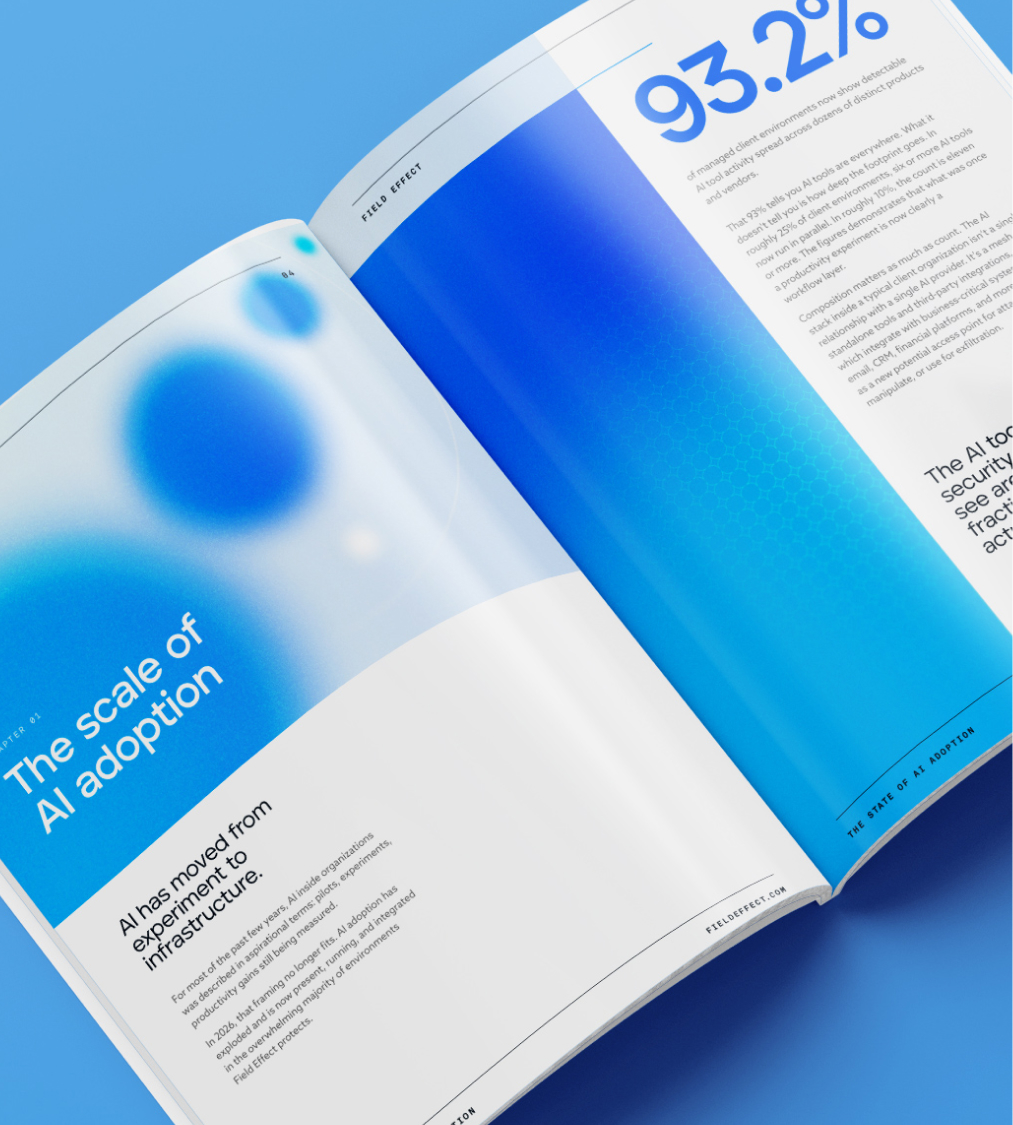
A glimpse inside the report
From the data, five patterns become evident:
- Detectable AI activity now appears in the overwhelming majority of environments, spread across dozens of products and vendors.
- Employees are bringing AI to work faster than an IT team can catalog it. In 88.1% of environments, at least one AI tool is used by exactly one person.
- AI agents, code assistants, and on-device local models each expand attack surface in ways traditional endpoint tools were never built to see.
- Security professionals acknowledge there's a gap. Most report moderate-or-below confidence managing AI risk.
- Almost no one is planning to forgo AI security, yet few know where or how to start.
Other key findings:
Common questions about AI governance
Shadow AI refers to AI tools adopted by employees without formal IT approval, vendor review, or data-handling policy. Unlike shadow IT of the past, shadow AI connects directly into business-critical systems (like email, CRM, file stores) so every unapproved connection is a potential route for data exfiltration or attacker access.
Traditional network monitoring and SaaS discovery tools miss a growing share of AI activity, especially browser extensions, locally-installed models, and agentic tools that operate with user-level permissions. Endpoint telemetry from a platform like Field Effect AIDR is currently the most reliable way to get a complete picture of your AI footprint.
They can be, and disproportionately so. Code assistants operate on developer endpoints that carry elevated permissions, access to internal source code, and connections to production systems. And because downloading files and running scripts is their normal behavior, traditional endpoint controls are often configured to exclude them entirely to keep them functioning.
Visibility first. You can't govern what you can't see, and most organizations currently can't see their AI footprint at all. Start by inventorying what's actually running across your endpoints, then layer in policy, vendor review, and employee education from that baseline. The eBook covers what a practical starting framework looks like.
Blocking is part of the answer, but it's not sufficient on its own. Browser-based AI tools, extensions, and locally-installed models are difficult to block completely, and aggressive blocking tends to drive adoption further underground rather than eliminating it. The more durable approach is visibility first, knowing what's running and who's using it, followed by a governance framework that distinguishes high-risk tools from lower-risk ones, so your blocks are targeted and your policies are actually enforceable.
Field Effect's 2026 survey found that the biggest barriers are process-related. Teams cited three issues most often: no clear guardrails on which tools can be used or which workflows require human oversight; limited employee understanding of why AI risk controls exist; and shadow AI adoption that makes policy enforcement impossible before visibility is established.
AI Detection and Response, included as part of Field Effect MDR, gives security teams a live view of AI tool activity across their organization. It helps uncover which tools are running, which employees are using them, which data sources are connected, and where shadow AI is operating outside policy. Rather than adding a standalone dashboard, AIDR builds AI context into the broader MDR picture, so AI-related detections are investigated alongside everything else. It's designed to turn the AI footprint from a blind spot into something you can actually act on.

CyberSecurity is our Priority
About Field Effect
Field Effect, a global cybersecurity company, is revolutionizing the industry by bringing advanced cybersecurity solutions and services to businesses of all sizes. We build solutions that are sophisticated, yet easy to use and manage, so every business owner can get the hands-free cybersecurity they expect and the sleep-filled nights they deserve.
Field Effect
Cybersecurity made simple.
Businesses of all sizes should have access to world-class cybersecurity.