WHITEPAPER
The AI Governance Playbook
For security leaders, IT teams, and MSPs managing AI risk across their environment.
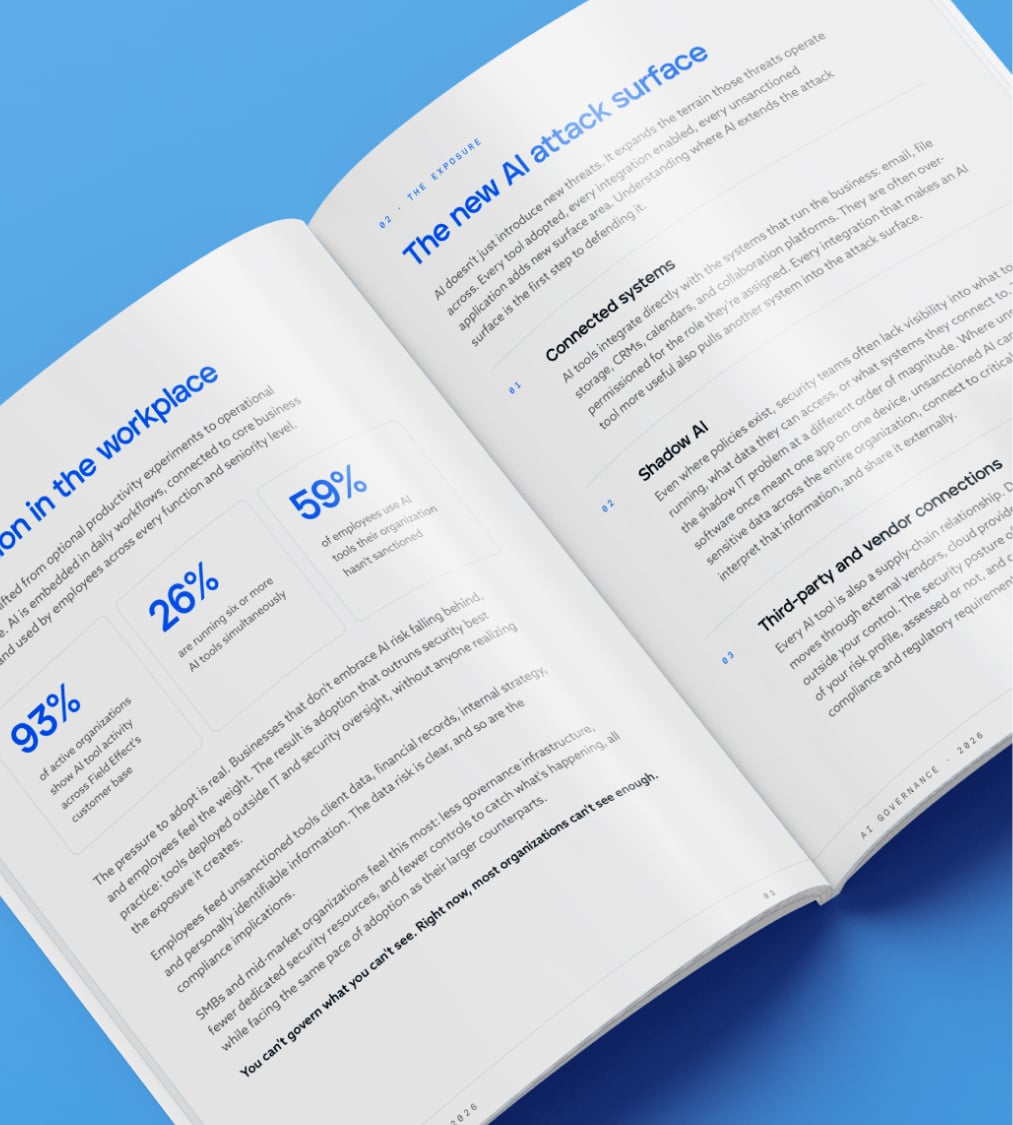
AI adoption has already outpaced your security team's ability to see it. 88.1% of Field Effect-protected organizations have an AI tool being used by exactly one individual. Traditional security controls weren't built for this, and most teams have responded by excluding AI agents from monitoring entirely.
This playbook gives security and IT leaders the controls, checklists, and policy framework to close this latest blind spot, without blocking the AI your business depends on.
What's inside?
Chapters:
- The landscape: how widespread unsanctioned AI use really is, and why SMBs feel it most
- The exposure: where AI expands the attack surface: shadow tools, over-permissioned integrations, and vendor risk
- Why legacy controls fail: why traditional tools can't detect AI-driven threats, and how attackers are exploiting that
- The framework: five practical controls with ready-to-use checklists for each
- Implementation: how to assess maturity, set risk tolerance, vet vendors, and assign ownership
- Adoption: six practices that make a policy stick instead of collecting dust
Key findings:
Common questions about AI governance
Shadow AI refers to AI tools employees use without IT or security approval—often connected to email, file storage, and other core systems. Unlike shadow IT of the past, unsanctioned AI tools can aggregate data across an entire organization, interpret it, and share it externally. Most security teams lack visibility into what's running, making shadow AI one of the fastest-growing sources of unmanaged risk.
Most organizations discover significantly more AI usage than expected once they start looking. A formal AI asset inventory, which catalogues every tool in use, who owns it, what data it accesses, and whether it's sanctioned, is the starting point. Field Effect AIDR provides the visibility layer that makes this inventory accurate and ongoing, rather than a point-in-time snapshot that goes stale within weeks.
No. SMBs and mid-market organizations are disproportionately exposed. They face the same pace of AI adoption as larger counterparts but typically have less governance infrastructure, fewer dedicated security resources, and fewer controls in place to catch what's happening. Across Field Effect's customer base, 94.9% of active organizations already show AI tool activity, regardless of size.
Update what you have. Most of what an AI policy needs to cover, things like acceptable use, change management, supplier onboarding, and incident response, already has a home in existing documentation. Creating a new policy for every AI consideration adds overhead without improving compliance. Fewer, fresher policies are easier to enforce and more likely to be followed.
Traditional security runs on known patterns and predictable behavior. AI doesn't. it interprets context and intent dynamically. AI agents also operate at the command line using the same tools as malware, run under a legitimate user's account, and can execute entirely in memory without writing files to disk. Most teams handle this by excluding AI agents from monitoring, which creates exactly the blind spot threat actors exploit.
AI incidents include data exposure through an unsanctioned tool, a compromised agent used to execute malicious commands, hallucinated outputs acted upon without review, prompt injection attacks, and compliance violations from data shared with external vendors. Legacy incident response plans typically don't account for these scenarios, and the speed of agentic AI means detection and containment need to happen faster than traditional workflows allow.
Annually at minimum, but more frequently if possible. New tools, new threat techniques, and new regulatory requirements are emerging continuously. Build a defined review cadence into the policy itself so it doesn't drift.
Field Effect MDR provides the detection, monitoring, and response foundation that makes AI governance enforceable rather than aspirational. Field Effect AIDR extends that coverage natively to the AI layer without any new agents or dashboards, giving security teams visibility into what AI tools are running, what data they're touching, and when something looks wrong.

CyberSecurity is our Priority
About Field Effect
Field Effect, a global cybersecurity company, is revolutionizing the industry by bringing advanced cybersecurity solutions and services to businesses of all sizes. We build solutions that are sophisticated, yet easy to use and manage, so every business owner can get the hands-free cybersecurity they expect and the sleep-filled nights they deserve.
Field Effect
Cybersecurity made simple.
Businesses of all sizes should have access to world-class cybersecurity.